

 Government communications professionals are scratching their heads about how to cope with looming demise of traditional journalism. Used to be you could just send out a few press releases, the press would pick them up, and your message was out there.
So how should the government communicate now that newspapers aren’t covering local news? It’s not like the news has stopped because the reporters are gone.
Personally, I’ve very excited about this coming shift. And I’m watching corporations adapt long before government. It’s time to get on board.
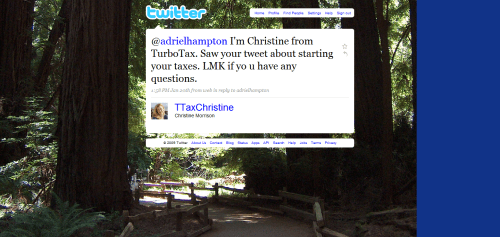
When I’m on Twitter and I mention a brand, often they will engage me right there. And brands don’t wait for a journalist to write about what they are doing – they go out there and market and tell people about it. It’s time for the government to market itself and get back into direct interaction with citizens.
The new media environment will force it.
 CampaignAdvertisements.com: Digital Consulting & Ad Strategy.
8 responses to “Gov 2.0: Positive Engagement”
I agree, obviously, Adriel, but it may be more important to fix the current state of government infrastructure before focusing on new/social media efforts.
For instance, if a government server is incapable of embedding photos and videos because of old server technology, that’s an important step to take.
Or, how about improving email servers to be ready to handle an influx of incoming messages?
Not to mention what I continually read on GovLoop and other places: many agencies consider archaic versions of Internet Explorer as de-facto–because of such-and-such policies. Policies are but another form of infrastructure to be fixed.
You’re totally right, Ari, but I guess I’m specifically talking about the woes of communications officials with the press not covering as many stories. It’s a big deal for smaller officials and agencies, all of which have press reps.
My response to that, Adriel, is to ask you to define the proper communications official. For the White House, I presume it will be their new director of new media, Macon Phillips.
But if you look at other states, the roles are different. Utah’s evangelist is CTO Dave Fletcher; and Massachusetts revolves around IT manager Sarah Bourne and gubernatorial new media director Brad Blake. And my hometown’s person? Nonexistent, unless you consider the mayor.
It’s actually pretty exciting to think about government being directly engaged with citizens. Government agencies have to adapt, true, but citizens will need to be more proactive in order to stay informed. More involvement on both sides; that has to be good.
In essence we have just moved to a new city and we don’t know anyone. The first step isn’t to throw a party. In other words you don’t first start a blog, you have to make friends. Online, in social media making friends is directly interacting.
As Adriel said, the best way to deal with this shift is for press officers to go directly to the bloggers and reporters who are reporting on their areas, to comment, and engage the public directly. If the formal media is failing us, the informal media has to be the solution. Getting out there building a set of online social skills to build relationships as press officers have always done offline is a solution. It takes time and a paradigm shift but the days of putting out a press release and making a phone call have left us with the reporters.
We haven’t stopped writing traditional “press” releases even though the local daily is shrinking (literally–the trim size is now smaller as well as the news coverage).
The trick is not to think of them as just for the press–rather, to see them as part of this direct engagement.
I was onto search engines pretty early in their development (remember when there were lots of them duking it out, before Google was a verb?). I soon realized that if I wrote longer releases, with more content, they were more easily found. (Didn’t know I was doing SEO)
Something as simple as putting news releases up online lets us go straight to the citizens whether or not an editor or reporter chooses to pick them up. Citizens looking for information can find it.
There is a catch. I’m still getting occasional inquiries about research we announced years ago because the archives are still out there. People don’t always look at the date on the release, or they’re asking if there’s any follow-up news.
Add the cumulative effect of dealing with the old news, which brings in old-fashioned emails and phone calls (even some from reporters, still), to the new expectations of social media.
We may be getting less “press” at the same we communicate with more people, more directly. We’re going to have staffing issues that can’t be addressed solely within communications functions. Being more accessible and available means having more people to deal with the workload.
Not to end on a note of doom & gloom, I think this is all great. My job includes community relations as well as communications, which has been great preparation for this world. We’ll be breaking down the distinctions between media relations and other elements of government communications with citizens, such as public engagement.
@BarbChamberlain
Thoughts on Social Media Releases?
Social Media Press Release 1.5 Template by Swift Communications
Click to access smr_v1.5.pdf
Looking Back at 14 Years of White House Website Designs…in Pictures…
There’s been a lot of talk over the past week about the new look of WhiteHouse.gov, from its blue hues to change.gov-inspired blog (this and other screen shots can be zoomed-in by clicking on them):
Jon Henke summarizes the key issues about the …