
Marxism, the systems-philosophy based on the political economy of Karl Marx, holds that history is the sum of material class struggles – that a society’s material production and distribution shapes its culture and consciousness, and that “progress” is reflected in successive revolutions creating more egalitarian material (economic) and political systems. Not surprisingly, Marxist views of the arts emphasize similar things: the underlying economic contexts of artists’ works, how those works represent class and class struggle, and how they give voice to defenses of the capitalist status quo or envision a post-capitalist world.
I want to briefly explain the relationship between Marxism and performance, specifically the performance of theater and film, which are “representational” and “narrative” forms of art. Theater and film are frequently of interest to socialists and other anti-capitalists (music is another common area of interest and there are Marxist graphic artists too), because there’s an innate collectivism and productivity in ensemble performance, set design, historical narrative, the representation of conflict, and the language of narrative dialogue. Also, performances can be educational; and, education is a political strategy for the anti-capitalist, teaching people how to criticize society and find common solutions through political organizing around an egalitarian agenda. Theater and film can be criticized for the way they represent the existing order, but they can also be re-constructed and re-deployed to create a new, radically democratic order.
In fact, Daniel Fairfax repeats, with the caveat “reportedly”, the claim that Lenin declared cinema “the most important” of “all the arts.” Mainstream cinema reproduces the dominant ideology.
What does critical, revolutionary, anti-capitalist film do?
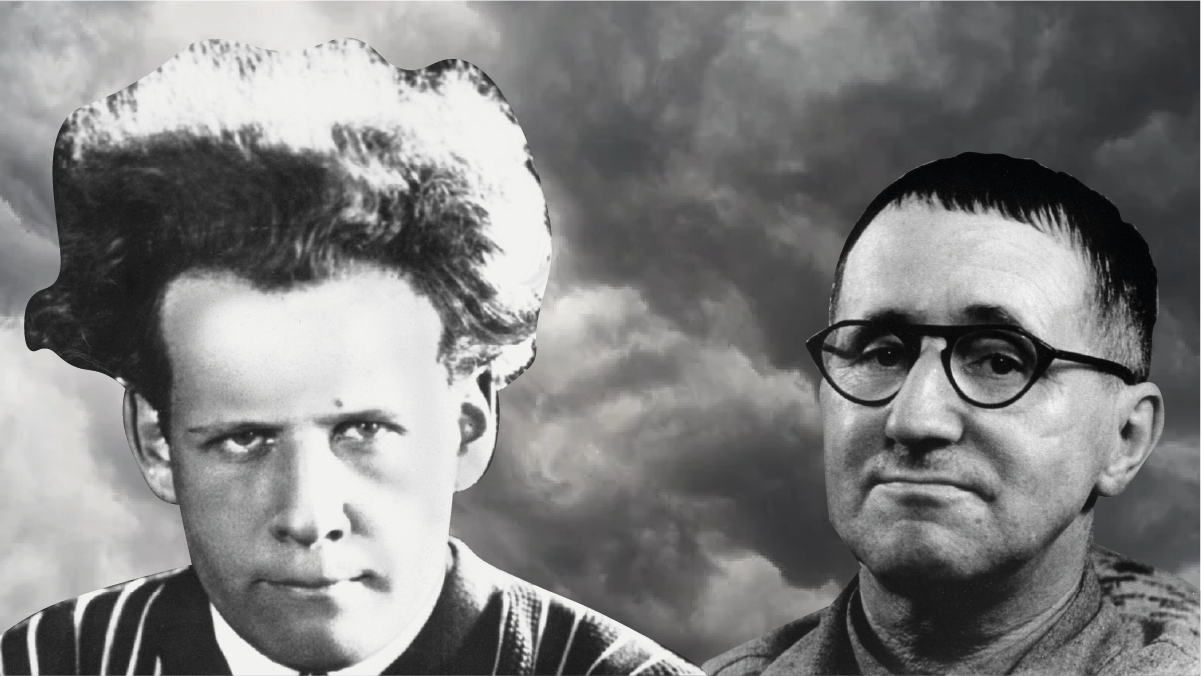
To explore the educational component of theater in relation to Marxism – the criticism of society, and the treatment of drama as didactic – we can turn to Soviet filmmaker (earlier a playwright) Sergei Eisenstein (1898-1948) and German playwright and dramatic theorist Bertolt Brecht (1898-1956).
Sergei Eisenstein’s most well-known contribution was “montage,” and with it he made unforgettable and technically pioneering films like Strike, Battleship Potemkin and October. Eistenstein learned montage filmmaking from Lev Kuleshov, who created the “montage” effect by cutting through many different perspectives, angles, actors, and parts of scenes in ways that created a motion and set of relationships. Montage creates “meaningful associations within the combinations of thoughts” to tell a story, compiling shots in a way that enables the film to no longer be bound to the chronological and expected sequencing. This makes the film dynamic and unbound by time and space. Eisenstein called montage “an idea that arises from the collision of independent shots.” There were different types of montages with different purposes, from eliciting and emphasizing difference to establishing visual continuity. Most importantly, according to Fairfax, “[i]ntellectual montage juxtaposes images to elicit cerebral responses rather than emotional ones.” In other words, intellectual montage is educational.
Bertolt Brecht wrote drama, poetry and theory. In productions like The Three Penny Opera (whence came the popular song “Mack the Knife”), Mother Courage, and The Good Person of Szechuan, Brecht and his ensemble (he was surrounded by brilliant actresses, songwriters and other dramatists; they came up with many of his ideas though he rarely acknowledged that) explored whether ethics were possible in capitalism. In other plays, like The Measures Taken, Brecht interrogated anti-capitalist organizing and revolutionary tactics, intending to educate his audiences on how to be good revolutionaries.
The purpose of Brechtian Theater, in fact, is primarily to educate, spark debate, and place our conventions into question rather than emote or romanticize. Brecht believed we should not lose ourselves in the romance, fantasy, or other removals of consciousness represented by conventional theater. According to Douglas Kellner, “Brecht’s epic theater was built on the Marxian principles of historical specification and critique . . . Brecht sought to illuminate the historically specific features of an environment in order to show how that environment influenced, shaped, and often battered and destroyed the characters.”
At the center of the Brechtian project was the use of theatrical exaggeration, outlandishness, and the obvious incongruousness. Characters were to be seen as characters, not “real people” (even though many of his characters, like Joan in Saint Joan of the Stockyards, did possess a lot of unique personality). The point is that the idea of “method acting” – of the player trying to “be” the character – was anathema to epic theater. Like Greek comedy and tragedy, a chorus and other surrealist components could make the production into a blatant series of arguments while still giving audiences a theatrical experience. The point was to learn to criticize and organize organically, as appropriate to the historical moment.
And Marxist theory, or at least Brecht’s interpretation of it, is foundational to Brecht’s plays, which consider situations brought about by our material systems or the struggle against them and relationships between people, whether soldiers, tradespeople, criminals, bankers, religious people, or shopkeepers.
In both Eisenstein’s intellectual montage and Brechtian epic theater, the form of presentation is designed to lift audiences away from “subjectivity”, or passive immersion, into the aesthetic. The productions are busy and blatantly artificial, challenging and confrontational, openly theoretical rather than populist. They are a pedagogy as well as aesthetic.
An interesting common thread between Eisenstein and Brecht is that they were both exposed to Kabuki theater. For Brecht, the exaggerated performativity of Kabuki would influence some of the basic axioms of his theory of epic theater. Kabuki influenced Eisenstein too: he believed it was “designed to act upon all of the spectator’s sense organs at once,” and this made him think about how to bombard audiences with imagery. This technique of producing to affect reflects an optimistic, late modernist revolutionary ethos.
Both Brecht and Eisenstein became huge influences on modern and contemporary theater and film. Brecht deserves credit every time actors break the fourth wall or some emergent meta-production occurs (characters walk off the sound set into the guts of the studio, or talk about their production in the middle of it). Of Eistenstein, Jason Hellerman writes: “Editing began to inspire filmmakers to set up more shots and take more chances. We saw the French New Wave and American New Wave take these montage ideas and build incredible narratives.
They changed editing and became the basis of storytelling. Now, we expect these kinds of edits and montages. They are almost second-nature to us, a universal way to transport viewers and share emotions.”
 CampaignAdvertisements.com: Digital Consulting & Ad Strategy.